Category Archives: Writing

Interview: Callie Stoker, Editor

CallieheadshotAs part of the official launch, I have the privilege of interviewing the talented Callie Stoker, Editor of Secrets & Doors available from Crimson Edge Publishing. Callie is a freelance editor and owner of The Manuscript Doctor.


SDSebookCover

Open the door and unlock the secrets in eleven short stories from The Secret Door Society, an organization of fantasy and science fiction authors dedicated to charitable work. All proceeds from this anthology benefit the Juvenile Diabetes Research Foundation in their quest to cure Type One Diabetes (T1D).

In these pages you’ll discover a modern woman trapped in an old fashioned dreamscape, a futuristic temp worker who fights against her programming, a beautiful vampire’s secret mission disrupted by betrayal, a sorcerer’s epic battle against a water dragon, the source of magical mirrors—and more. There are tales for every science fiction and fantasy taste, including new works from award-winning authors Johnny Worthen, Lehua Parker, Christine Haggerty, and Adrienne Monson.

Join us in the fight against T1D as you peek into a world of magical and mysterious doorways—if you dare.


In my own history as a reader, I never knew the value of an anthology and rarely picked them up. A collection of short stories gives you a taste of the writing style of many authors and could be the way you find your next favorite, or decide which novels you’re willing to take a chance on. Being one of the authors in this anthology, I know exactly what went into creating my individual piece. The editing process is more of a mystery. I wanted some insights – secrets even – so I sat down with Callie to get all the insider information I could.

Secrets & Doors is an anthology with eleven authors, but your name is the only one on the cover. How does that work?

The decision is ultimately up to the publisher. Some anthologies will include the author’s names on the cover, although that can often result in a busy and confusing image. For this anthology it was decided that a streamlined cover with a beautiful image would sell best, and I think we are all very pleased with the result. The editor is often the driving force behind the creation of an anthology, sending out a call for submissions and choosing from those submissions, and thus usually receives a publishing credit on the cover. The creation process for this anthology was a cohesive and synergistic one. Although my name ended up on the cover, that shouldn’t overshadow the incredible work by the Secret Door Society in writing, polishing, and perfecting their stories. I think we accomplished a lot with this collection and I’m very proud of it.

Tell us about your journey. How did you become an editor?

I started out as a writer! A wonderful group of me and three women expressed an equal desire to write, so we formed a writing group called Once Upon a Keyboard. This was ten years ago and since then, two of the women have been published, I became an editor, and we gained a new member, a copy editor, over a year ago.

My shift from writer to editor is expressed perfectly in my favorite quote by E.B. White, “An editor is a person that knows more about writing than writers do, but has escaped the terrible desire to write.” This fact was a frustration to me early on when my writing buddies would talk about their stories with such passion and I struggled to eke out a plot from a single idea. My passion emerged as I read and critiqued my fellow writers’ work. I was able to see the weakness while praising the strengths. I could clearly define what wasn’t working and put them on the path of how to make it successful.

I’ve spent the last several years intensely educating myself in the craft of writing. I believe that a good editor teaches and instructs while critiquing so that the author is left uplifted and inspired to apply a better understanding of craft to their future work.callielogo

I launched my personal business in 2014 and its success has shown me the current need writers have of an editor that can not only correct punctuation and grammar, but supply individualized instruction based on writing craft.

What goes into editing an anthology?

Anthologies are a collection of short works (stories, essays or poems) tied together by a common theme. It is the editor, often called the curating editor, who sends out a call for stories fitting the theme and reads and selects from the submittals. The curating editor also chooses the order of the stories so that each transition creates the best experience for the reader. Finally, the curating editor takes the lead in the editing process, completing or overseeing the stages of revisal.

What do you like the most about the editing process?

I am unendingly impressed by the creativity of writers. It is often said that there are no more “new ideas,” yet there are also infinite new perspectives on old ideas. I often feel privileged to read a writer’s fledgling ideas and witness as they develop. I love helping the author see how their ideas can be coaxed and nurtured into a successful story by helping them understand what kind of a story they are writing and how to make each scene and each character leap off the page.

Anything you wish you didn’t have to do as an editor?

At times I’ll need to change the tense or point of view of an entire manuscript which can be a little tedious. At the same time, making these changes is extremely satisfying when the end result is a clean draft. Proofreading may be the most tedious of tasks, but there are creative ways to go about it like changing up the font and size of the document to trick your eyes into seeing it for the first time, or reading the manuscript backwards so that you forget the story or the grammar and see only the typos or misspelled words. Sometimes I enjoy mixing up my content editing work with these tasks.

What other projects are you currently working on?

I have an ongoing client list that keeps me always reading and editing. These clients include published authors, unpublished writers, screenwriters, bloggers, and non-fiction writers. I am currently working with a publisher on the second book of a series and look forward to working in the future as a freelance editor for publishers.

Any free advice to any aspiring writers out there?

First: Read. Read. Read. Read your genre. Read outside your genre. Read the greats. Read the current stuff. A big part of storytelling is about story tropes. Tropes aren’t a bad thing, they are a recognized story form and there is a reason they exist: because they are story types that are repeated again and again. When you know the tropes, you are better equipped to treat them correctly in your own writing and to know what has come before and how to build on it. I can promise you that your level of reading will affect the depth of your writing and increase your creativity.

Second: Know what kind of story you are writing. This may seem simple and obvious, but I’m not just talking about genre and demographics (although knowing these is also important). Are you telling an adventure story? A mystery? Is this a character development story or a save the world story? The best tool for discovering this is Orson Scott Card’s M.I.C.E. Quotient. If you don’t know it, learn it. Every story is either a Milieu (Setting), Idea, Character, or Event story, or a mixture of these. When you know the story you are writing you’ll know where to begin and end your story, what conflicts to focus on, and how to create the most satisfying arc for your characters. This is the number one thing I work on with my clients.

Where can readers find you?

Please visit my website, www.themanuscriptdr.com, to see what kind of services a freelance editor can offer. If you are curious about what level of critique could help your own work, you can submit your first chapter through my website for a free sample edit. Perhaps a personal editor is exactly what your writing needs to get you to the next level.

Also find me on Facebook and Google+ as “The Manuscript Doctor” or Twitter @themanuscriptdr

Check out my writing group’s website, www.onceuponakeyboard.com. We’ve compiled the best articles, links, videos and podcasts on writing advice. We’ve done the research so you can do the writing.

***

If you’d like to pre-order your copy of Secrets & Doors, you can do so at the following links.

Paperbook: https://www.createspace.com/5209804

eBook: http://www.amazon.com/dp/B00SNUZYGE


Secrets and Doors Anthology – Coming Soon

I was going to write a big post about what is happening with my story in the anthology* releasing next month.  But, then the publisher wrote this great article. I’m just going to point you all to it so you can hear directly from the source.

Secrets and Doors Anthology – Coming Soon.

It has been such an honor to be part of this project with The Secret Door Society. There are amazing stories for everyone to enjoy and we get to help in the cause for a very common but terrible disease.

Next up: the cover reveal sometime next week! Stay tuned…

*Anthology = a fancy term for a collection of short stories. A great way to sample the work of many authors to determine if you like their style enough to pick up an entire novel.


Business versus Craft – the 2015 conundrum

There are only so many hours in every day, no matter how effective you are at using them wisely. I’m not sure whether it was a funk I was in over the holidays while I grieved celebrating without my mom, or a mild case of burnout. More than likely a tad bit of both. I spent the last week making a conscious effort to get myself refocused. For the first time, I wrote down writing goals for the year. Measurable ones with dates and everything. Which someone said makes them far more concrete. I’m not really a written goal kind of girl but yearly goals are part of my corporate job which shapes my efforts over the course of the year. It was not surprising to find myself in the same kind of mind-set thinking about my writing. I have taken my hobby to a professional level and it just flowed naturally to set yearly targets for productivity.

I have some lofty goals for 2015: two novels and several short stories by the end of the year.

The reality is, if I want to achieve these goals I am going to have to step things up even further this year. I’m going to have to start saying ‘No’ to things… I’ve been involved in creating a new non-profit organization the past few months and it took a lot of time. Time I could have been writing. (No surprise that I’m also on the pro tempore Board of same, right?) But it was because of my involvement with that group that my first story will be published so I have to believe it was worth it. I’ve been trying to juggle so many things that some of the balls I’ve got in the air are bound to fall on the ground, try as I might to catch them. Gone are the days where I could say yes to everything that I spontaneously thought sounded fun and then find a way to work out all the details. Now, it’s called prioritizing and I have to do it before the fact. Instead of lamenting, I’m thinking how great it is to have these business-related problems. It means I’m a professional which will help in getting to the next level. A level I can’t fathom at this point but which I welcome nonetheless.

I’m working on a new ITIL certification at my corporate job called Service Strategy (it’s an IT thing, it’s okay if you don’t know the reference, google will). One of the principles I thought fitting for my current situation is: ‘Strategy is deciding what not to do’. Basically putting what your business plans to do in perspective of what you have time, money and resources for, and what you don’t.  I never thought I’d be using my corporate job skills in my writing career but here I am, doing exactly that. Hours of time to allot for writing is the most precious of commodities right now for me. I can either use them for writing or networking or marketing or creating new and exciting ventures that benefit the community and advocate literacy. But I won’t have the time to devote to each of them that I want. Maybe I’ll win the lottery and I won’t need the corporate job anymore. I find myself day dreaming about how much I could get done at work if my only job was my writing. But I can’t dwell on things as unlikely as wining the lottery.

As a result of my introspection, you won’t see me at FanX, probably not at ComicCon either. Plus, I’m being selective on which writing conferences I attend this year. Because that gives me three more weekends to devote to marathon writing sessions where I practice the craft that helps me excel in my business. Truth is: without my craft, there is no business. If I’m not writing and producing products intended for consumers, all the rest of my networking and marketing efforts will be fruitless in the end.

Now, more than ever, if you need me I’ll be writing. I’ll sure miss watching football, since I’ve already given up the rest of television. Perhaps I should buy stock in a coffee supplier just for safe measure? I will certainly need my share of caffeine in the coming months while I watch 2015 unfold. Stick around, there’s always hindsight when we can’t have a crystal ball!


The Art of Combat – with Joshua Robertson

Today I have the pleasure of hosting Joshua Robertson, author of the upcoming Melkorka from Crimson Edge Publishing. I asked him to share some writing tips and he was nice enough to oblige. Thanks, and welcome, Joshua!

***

The Art of Combat

In younger years, I always thought that R.A. Salvatore was the master of writing fight scenes. If you have not read his works, I would suggest starting with Homeland, Book 1 of the Dark Elf Trilogy, featuring the legendary Drizzt. This fantasy author presents combat so well that it appeared to naturally flow in his novels in the same way that other storytellers would write about the scenery. When I think of exceptional fighting in novels, I still think of Salvatore.

Those that have read my novels tell me that I share this strength in my writing. If anything, I assume that this comes from years of playing tabletop RPGs, combat-oriented video games, and sparring with my brother throughout the years. I will leave it to the fans to decide how well I actually execute combat in my novels. However, I wanted to take an opportunity to share just a few tidbits on improving your written combat. My disclaimer to these tips is that I don’t always follow the rules. Sometimes, it is important to intentionally neglect them to capitalize on something within a scene…and sometimes, I simply forget. In any case, it is good to keep these concepts handy!

Keep It Quick

A fight scene is supposed to be fast paced and tense for the character. This is not the time to be explaining how the horizon melds perfectly against the tree line. You want to keep the language in the book glued to the fight scene when it is taking place, while maintaining a flow that does not make it confusing for the reader. What do I mean by that? The English language can be molded in many ways to enhance your writing. Changing passive sentences to active sentences will change the entire feel of a fight. However, I think the easiest rule to begin with is to cut your adjectives and adverbs. They slow the reading process and destroy the emotional feel that most authors believe them to enhance.

John fiercely thrust his serrated sword forward and quickly pierced through the knight’s armor. [or] John thrust his sword through the knight’s armor. You get the idea. One example gives a fancy visual for speculation where the other pushes the reader into the next line of action. Combat is a time for action.

Another quick tip, if the terrain is an important element for the combat, then you must set it up in a previous scene or prior to the combat. Good writers will lay the groundwork well in advance of when it is actually needed.

Use Suspense

Suspense is your friend. Take any great fantasy novel and know that you are spending the first hundreds of pages preparing for a climatic end that may only last a few pages [or paragraphs] at the end. One of my beta readers for Melkorka shared with me that this was an element of the novel that kept him turning the pages. And, even at the end of the novel, he was yearning for more.

In reality, most fights do not last long. Anyone else watch UFC in their spare time? A couple of minutes and the entire conflict is over. You may watch commercials the entire week prior to the fight, and then watch someone be beat to a pulp for 45 seconds. The trick for the fantasy writer is having this also be reflected in the novel. Well-structured suspense is what makes that fight scene great.

Be Clear

Your readers will lose interest if they cannot visualize the scene or the characters placement. It is not everything, but it is important to know your battleground. I have done fighting scenes many ways. I have used maps, figurines, or even danced around my house to practice different maneuvers with swords and whatnot. The author has to know what is going on in order to tell the reader what is happening.

Without being too stereotypical, fantasy has long been a genre for nerds and geeks. As you may have guessed that we within the nerd community have certain expectations. We like things to be realistic within the guidelines of the genre. Sure, magic exists – but there are certain rules and properties it has to follow, right? Fights, including pure physical combat, also have rules to follow, such as force and leverage. You will find that readers can forgive some of these mistakes in a well-written novel, but if it is consistently flawed, you will lose your audience. Conducting fight scenes requires the author to conduct research. You have to know the weight of a sword, the reloading rate of a crossbow, the distance a person can jump, and what impact a lance has on iron armor. Then, once you know what you are talking about, write the scene be clear, accurate, and realistic.

Be Purposeful

One of my biggest peeves in some fantasy novels is fight scenes that have nothing to do with the plot structure or character development. Many times you will find authors that will write fight scenes without any purpose, or they will defend the scene with “This scene is important to demonstrate my MC’s strength and agility.” That, my friends, does not advance the plot. It is filler and confuses readers because they are looking for a deeper connection and how this particular scene ties into the character’s motivations. It is not helpful to open your book with a scene of a character fighting a band of robbers on the side of the road, unless those robbers are an intricate piece of the plot line.

Why is this important? I think the primary reason is that the reader grows to skim your battle scenes, no matter how important they could possibly be. If I am frequently reading about punches, kicks, and parries in the novel, then the combat begins to lose its meaning. I can remember great scenes in Tolkien and Jordan and Sanderson because the motivation of the characters enhanced the fight. There should always be a good reason for combat.

***

MelkorkaFinalFrontCoverKaelandur was forged by the Highborn to slay one of their own, Nedezhda Mager. As their slave, Branimir Baran never thought to question his cruel masters until he is forced to take part in the execution. His actions begin a chain of events that will lead him to confront demons, cannibals, and himself as he is forced to question his own morality and the true meaning of good and evil.

Book One of the dark fantasy series, Thrice Nine Legends, available on Amazon January 2015.


Author Bio

Joshua began crafting the world for Melkorka in 1999, and has since continued writing flash fiction, short stories, poems, children’s books, and epic fantasy novels. Joshua is the author of the transitional children’s book, Bo Bunny and the Trouble. He is also the co-creator of the fantasy tabletop game, Thrice Nine Legends, due to be released in 2015. Joshua currently lives in Alaska with his wife and children.

 You can find Joshua at the following links:

Facebook

Twitter

Website

Crimson Edge (Melkorka Ebook available for Pre-Order Now)

JoshuaRobertson


My Wife is a Writer

This is the week my little family typically heads to a beach somewhere to get away from the Utah cold and reconnect with each other; no school, no work, no dance and no pressures of everyday life to interfere. This year we booked a trip to a more expensive exotic location later in 2015 and instead are enjoying a week of staying home from the day jobs while the kids are out of school. Lots of heavenly reading, watching movies together and hanging out with family and friends – in sub-zero weather.

The other night, Hubby and I ditched the kids for a rare evening out alone at our favorite Tai place. There was a large group of women who were having some kind of a celebration. Nothing obnoxious, but the typical noise of many people talking over one another was unmistakable and added to the festive ambiance of folks out on their holiday errands. As we were leaving, we walked past their party, which was breaking up, and Hubby (who talks to everyone everywhere) asked several of the ladies if it was girls night out.

“No, just our book club” one of them said.

And with one sentence, my husband completely rocked my world…

“Really? My wife is a writer!”

It is rare for me to be speechless but, for a moment, I was. As if in slow motion, all eyes turned to me with that shine that all readers must have when they meet a Real. Life. Writer. I know that’s how I used to feel before I spent so much time with other authors that they have become commonplace. Several of them asked “what do you write?” and I recovered my wits quickly enough to answer “Science Fiction, mostly”. But their reactions were not what caught me so off guard.

I’ve been married for twenty years and my husband always introduces me as “my wife who works with computers” or “my wife in IT” or “my wife who drives a forklift” which was a funny inside joke when I worked in IT for a heavy equipment dealer. This was the first time he’d introduced me with five little words that knocked me sideways: My wife is a writer.

As we walked the rest of the way to the car, me grinning ear to ear and obsessing about what else I could have said like any neurotic writer would, I realized that more than what I do with my free time has changed this past year. My efforts to “someday” be a writer have brought me here, where my someday is now in the present. Who knows if I’ll ever write a novel that most people have heard of, or sell thousands of books. But it doesn’t matter. Because I’m living my dream of being a writer.


The evolution of November

December is here and with it came the end of this year’s NaNoWriMo. So many things have changed for me this year. The drastic shift started back in February when I decided to start actively pursuing this insanity called publication. So I shouldn’t be surprised that NaNoWriMo and the part it plays in my writing has also changed. This year I’m not working on a new story, I’m revising an old one so I can sell it soon. That’s the plan anyway. Even knowing that’s where I’m at, I still feel guilty that I didn’t “win” this year. That’s how much a part of me this silly thing I do every November has become.

What did I do in November INSTEAD of finishing NaNo? Lots of things…

I’m working with some amazing authors to create a non-profit organization for writers with a community and collaborative focus rather than book sales. A professional organization for writers like no one has ever created before that gives back to members at all levels as well as the public at large. It’s super fun but part of me wonders why I gravitate to being in charge of things rather than just being a participant. Not in my nature apparently. It doesn’t feel like work, but if you add up all the time I have put into it, I’ve done quite a lot the last month toward this collective vision that we hope will be amazing.

I submitted a short story to a very prestigious writing contest for as-yet unpublished authors. Wait, I know I’ve been hinting at publication news for a while now but I still don’t have a signed contract to purchase my story. It is slotted for a short-story collection due out next year but until the deal is done and signed I’m not talking about it as a past-tense reality. Doesn’t mean I’m not super excited about it, I just don’t want to jinx it. Yes, deep down I’m a neurotic writer. See? This contest comes with cash prizes for the winners and some pretty impressive writing credentials if I’m a finalist – including publication. But I won’t know until months from now. And we all know how impatient I am. Luckily I have things to take my mind off the waiting. This was one of my specific goals for this year so checking it off my list was a pretty significant milestone for me.

Because I do have a pending deal, I must have a “real” website with a URL that doesn’t include “blogspot” or any of the other free sites. In other words, I have to get legit. So in all my free time (ha!) I’m building a website to migrate my blog to. Don’t worry, you’ll be able to follow me when I go and, if everything works out the way I hope, all my past content will come with me. We’ll see when I get to that point. Building websites is not a job I want – full time or part time. It kind of sucks. I’m really good at what I know and having to start over with an associated learning curve is frustrating.

Because I have to get legit, I had to get professional head-shots taken so I can use them everywhere people expect. Prompted by a deadline for said pending publication deal, I had to get them done ASAP. Imagine my horror when I found out you can’t use your smartphone to take a selfie and use that. I was a photographer in a past life before I started writing and I’m better behind the camera than in front of it. However, I’m pretty happy with how they turned out. It helps to have a long-standing relationship with a photographer you trust… Voila! Big hair to match my big personality.

Hubby said the other day, when I was apologizing for all the time I’ve spent away from normal family life lately, that it was to be expected since “writing isn’t a hobby anymore”. Imagine that. My hobby isn’t a hobby anymore, it’s a business that will someday pay off. I have no delusions of ever replacing the lucrative income from my corporate job but you never know. Stranger things have happened.

I let a beta reader take a gander at my story that’s getting ready for public appearance. She immediately started drilling me about the world I’d built and characters I’d created that had already become real to her. She needed answers and she needed them now. Guess I better get cracking on THAT novel soon, too.There are now more stories and novels in the pipeline than I ever thought possible.

When I look back at where NaNoWriMo has taken me, I’m okay with my Novembers evolving into something different. Maybe next year I’ll be in the first draft arena of another story so I can participate. If not, at least I’ll still be writing!


Why you can’t "do" NaNoWriMo if you are revising – my latest epiphany

Remember when I said I wasn’t going to do NaNoWriMo this year? And then I decided I was a big fat liar since I was going to do it but bend the rules and not write something new? I’m here to tell you it wasn’t a good idea. When I’m drafting a brand new story, I can bust out a couple of thousand words a day and finish while still having a life – or whatever my life usually resembles. Revisions are not the same as vomiting a story from your subconscious with the motto running through your head of “Write First, Ask Questions Later”.

I’ve written consistently this month – six days a week with the exception of the two days I was too sick to stay awake that long. But I only have 20,000 words to show for it. So what the hell is happening?

Revisions are FAR different from first drafts. I delete more words than I write because I’m focused on quality rather than sheer quantity. I’m trying to write coherent scenes that tie together and take my characters from where they are to where I know they are headed. The place they must be headed if the story is to remain consistent. And entertaining. And marketable. And entertaining. You get the point. So while I’ve been consistent, I’m only averaging about eight hundred words a day.

I started out the week feeling dejected as I saw everyone I know near the finish line. I felt stressed that the goal of “winning” with 50,000 words was slipping further and further from my grasp as this week continues with more of the same productivity. But then I remembered that my personal goal this year is very different. I’m still on track for that goal which is the only thing that’s important.

I will “win” when I finish this revision by the end of December. Oh, and submit a short story to a writing contest. Because why not? I’ve had the idea knocking around in the back of my mind and recent events make it possible to do it without treading into murky “it can’t be published yet” waters. (First rule of publishing: release deadlines never stick!)

It is uncharted territory I’m exploring. The path to figuring out exactly how to write a novel was long and fraught with hardship. Now I’m on what I’ve declared as the path to getting published. I fear it will be just as difficult and just as fraught with obstacles. But damn it’s exciting to be here!


Halfway there check-in

What is it with November? Do I get sick every year coincidentally or is it a side-effect of NaNoWriMo? It is week three and I’m behind because week two – the dreaded week two – had me sick and unmotivated. Week one went splendidly and I was on track for the minimum recommended word count. Week two, I penned in the couple of hundred of words a day range instead of the thousands that I needed – if I wrote at all. Now I’m thousands of words behind.

I could wallow but the real goal is to revise this novel so I’m focusing on the fact that I’ve written seventeen thousand words toward that. I’m still plugging along and loving this revision process. I know exactly what the ending looks like, and exactly what I need to be writing toward from the beginning. I know what needs to be foreshadowed, and what motivates my characters. Most of them, anyway. About half of what I’ve written is brand new stuff because I added supernatural elements and changed the story in fundamental ways. It’s been fun, even if it’s been exhausting. I could definitely get used to this revision thing thanks to having a fabulous developmental editor I can employ as soon as the first draft is written.

See you on the flip side of November… win or lose I’m sure to be sleep deprived and highly caffeinated but loving every minute.


Halloween Challenge Micro-fiction

The challenge: write a story in 250 words or less. Challenge accepted! If you want to read more free stories from local authors who also accepted, check it out HERE, sponsored by Utah Fantasy Authors.

“Little Red”

My body jerked awake, the doorbell yanking me from the brink of sleep.

 “Trick or treat!” came muffled through the door, probably teenagers looking for mischief. The little pirates and sparkling princesses had long since dwindled. I’d dozed off before extinguishing the porch light but I still had candy in the bowl. Better get to it if I didn’t want a trick.

I smoothed my rumpled costume and lifted the red hood over my hair. Reaching into the bowl for a handful of the requisite sugary nonsense, I opened the door.

“Looks like you’ve been expecting me,” the wolf face said with a chuckle. Did those lips move? The make-up these days was getting so elaborate.

“Great costume. Aren’t you a little old, though?” Where was the candy bag ready and waiting to accept my offering?

“Not for what I have in mind, Red,” he growled, fangs and inhuman bone structure flashing in a burst of movement.

Claws dug into my arms like tiny knives shoving me back inside the house, hot breath in my face. My vision tunneled and I screamed as the creature kicked the door shut. Heartbeat frantic, I grabbed for anything within reach that would help. Candy bowl clattering, nothing.

“Take whatever you want, just don’t hurt me.”

“Mmm, what I want will hurt, my treat.”

My head smashed against the tile. The weight of him on top of me registered as my throat erupted in pain. Ripping sounds filled my ears.

Copyright Terra Luft 2014 All Rights Reserved


Embarking on Revisions – and why I’m a big fat liar

Game on for NaNoWriMo 2014! Wait, what? I know. Right now you think my addiction is showing and pray that I get some help after my confession just ten short days ago. But let me explain…

When I set out last year to write my second novel, I swore it would be the one that I figured out the fearful and overwhelming process of Revisions with. All of 2014 so far has been devoted to just that. What I didn’t know, is that after I employed the services of a developmental editor it would be necessary to re-write basically every scene. Every. Single. One. Oh, and add in more of course and layer in more elements that are still missing.

My editor is phenomenal. Sometimes I hate what she tells me but it is always spot on. Seriously, if you’re a writer and you haven’t found an editor you trust then you have a moral imperative to find one. After ten years of working together, I know I can trust her not to lead me astray. (She is for hire, if you’re in need.)

I got my edits back a couple of days ago, had a meeting with her (on our yoga mats, it was beautiful) and hashed out the big things that need to be tackled. I came away knowing that while I am not writing a new story this November I’ll be completely re-writing my current one. I may as well use the website tools to track my progress and milestones and keep me on track and motivated for the entire month. Does it make me any less of a NaNo’er that I am writing 50K works of a story I’ve already hashed out? It might, but I don’t care. I will donate to cover the costs of my usage and my conscience will rest easy about my little white lie.

Holy shit, I have 11 days to prepare! And lots of questions still unanswered. Better get brainstorming… If you need me I’ll be re-visioning. Otherwise known as re-writing. There’s still time to join me and all the other November novelists at www.nanowrimo.org


Why I’m NOT doing NaNoWriMo this year

It’s October. Weeks away from my historically statistical most productive writing month of the entire year. My email is hopping with updates from National Novel Writing Month (NaNoWriMo) getting me geared up and ready. My creative juices are already brewing and I’m on a roll with new material waiting to spew forth…I’m like an addict in need of intervention!

Hi, I’m Terra and I’m addicted to NaNoWriMo and writing first drafts.

It’s been a very fruitful year for me in the writing department. And my writing group already intervened months ago forcing a commitment from me to revise one of my first drafts between now and February. I told them I would be ready to pitch to agents and publishers by then to see if I can get someone to buy one and publish it. So, I won’t be using November to write a shiny new novel – a skill I’ve mastered after having done it so many times already. Instead, I’ll be revising. A piece of the craft I have yet to master as well as the first draft. Probably a better use of my time in the grand scheme of things.

After LTUE last year I committed to writing short stories to figure out how to revise on a much smaller scale. I did it – with a story I’m super proud of but which is on draft number seven – seven – in preparation for publication. (Yes, I might have some very exciting news coming soon!) If it takes seven drafts of a novel to get it ready, I’ve got a lot of work ahead of me. Guess I better get to it! If you need me, I’ll be writing – I mean editing!


Heart of Annihilation

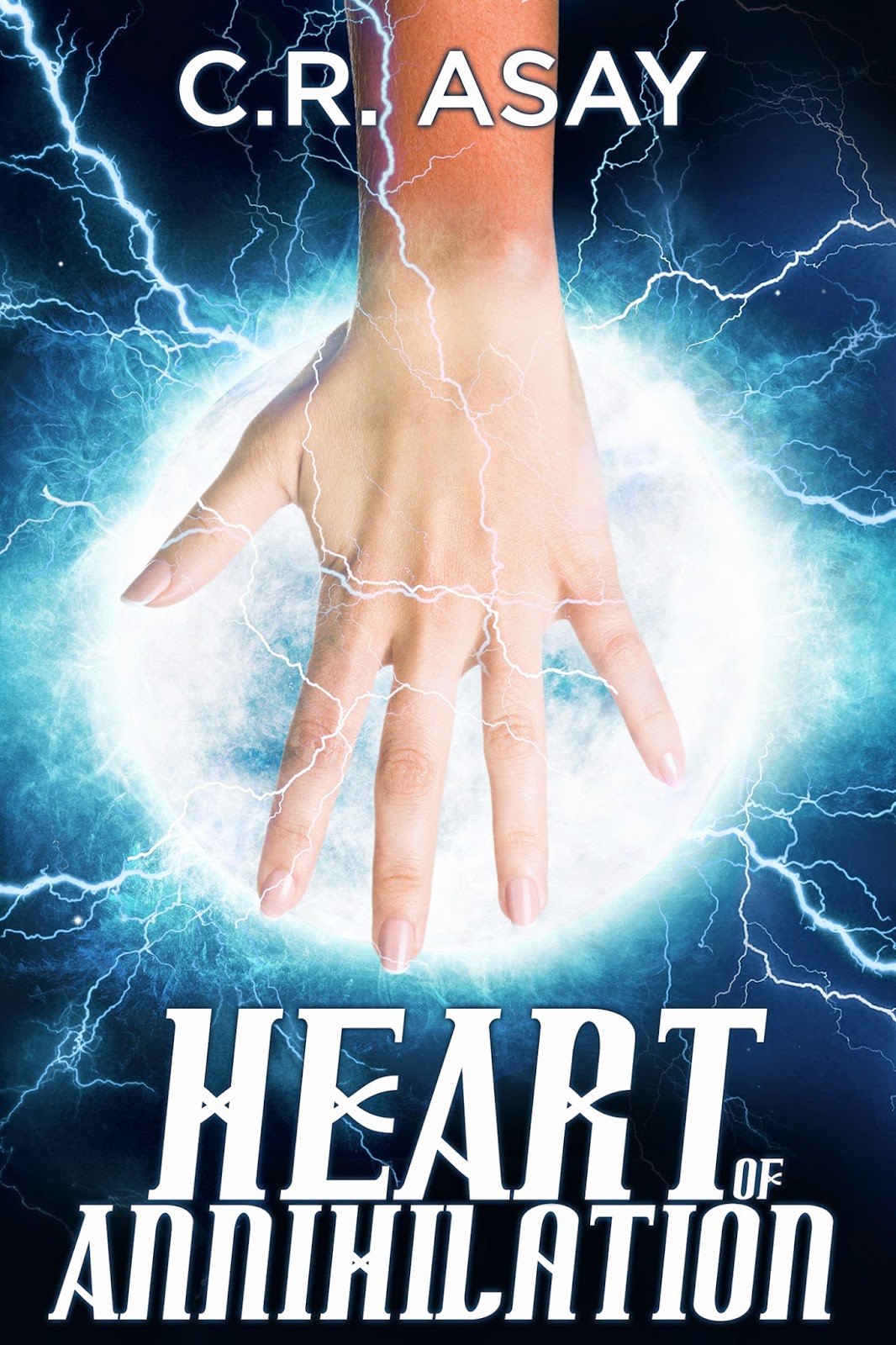
Today I have the honor of kicking off the blog tour for one fabulous book – Heart of Annihilation by C.R. Asay. A book with a very special place in my heart. C.R. is a member of my own writing group so I’ve watched and participated intimately through the entire creative process. I’ve read it countless times. It’s amazing. But don’t let my biased judgement be the only thing that sways you… it is an exciting and imaginative read that you don’t want to miss. Especially if you love science fiction with a military twist and a strong female lead. Or maybe it’s military with a science fiction twist? Just trust me and pick this one up.

When U.S. Army Specialist Kris Rose catches members of her unit stealing ammunition to kill aliens, she is forced to defend herself—with a freakish electrical charge shooting from her fingertips.

Shaken by her newly found power and hunted by vigilantes from her unit, Rose is forced away from her structured, military world and into a fight for her life. 

With the aid of her battle buddy, Corporal Thurmond, Rose sets out to learn more about the aliens under attack. In the process, she discovers her bizarre connection to a devastating threat to Earth—an alternate dimensional weapon called the Heart of Annihilation.

From a chuteless free-fall from 20,000 feet, to deadly bullet wounds and the unforgiving Sonoron Desert, Rose enters a world where aliens are real. And she may be one of them.

I sat down with C.R., otherwise known as Christauna, for an interview figuring I already knew all the answers. I was wrong… 
__________
 Where did your idea for Heart of Annihilation come from? 
Heart of Annihilation grew very slowly. I wrote a scene about Specialist Rose facing down a greasy, redheaded lieutenant with an M16 and then I let it sit for weeks. Maybe months. I sure thought about it a lot. Why was she there? What put her in that situation? I’m honestly not sure exactly how it grew from there. I knew I wanted something sci-fi. I thought aliens. My husband suggested dimensions. We compromised. I wrote a lot of disconnected scenes but it wasn’t until over halfway through the book that I knew where I wanted my characters to end up. Then it was just a matter of revising over the course of 5-6 years, molding the story like a clay sculpture until it resembled what it is today. I will probably never again write a book the way I wrote Heart of Annihilation. This one is special. 
I remember that first scene well… And now here you are with a book you can hold in your hands. So cool! Every parent secretly has a favorite child – do you have a favorite character you love more than the rest?
 Yeah…Thurmond. Definitely. He’s just such a rock solid person and decent human being. He epitomizes how I see the U.S. soldier. He’s a hero. It also helps that he has a lot of the quirks and personality traits I see in my husband…
What is your secret to writing violence?
 You can’t pull any punches, no pun intended. Human beings are the best, most gracious creatures in the world, but they are also the vilest. Just turn on the news and you will see a lot of worst-case scenarios. When you’re writing a book that naturally contains a lot of violence, sometimes you need to look deep inside yourself and write what is most distasteful to you in order to elicit the same emotion in the reader.
I wrote the whole storyline for the character Caz Fisk in about two weeks of almost constant work. And I hated it. I hated sludging through her mind and wondering what hateful thing I was going to have to write next. It was a dark two weeks that left me in a sour mood and short tempered with my children. Editing those sections later wasn’t as bad as the writing, but having to channel her violence was very unpleasant. And they turned out great.
Caz is actually my favorite character – because she’s so gritty and violent. You nailed it. Is this a stand-alone or is there more to come?
I anticipate this to be a 3-4 book series (I’m aiming for 3). The second book, working title Miss Risk, is complete in rough draft form. Book 3 is in the early stages of drafting.
How long did it take you to write Heart of Annihilation?
Write or edit? The writing probably took about a year. The editing/revising? More like five years. That’s not normal, even for me, but Heart of Annihilation is the first novel I wrote and so it was the one on which I learned the writing process. Usually an author will abandon their training novel and just write a new one in order to grow as a writer. The plot and characters in Heart of Annihilation were so compelling to me that I couldn’t let them go. So I revised into publication.
I like the sound of that: “training novel”. I might have to steal the term. What exactly is your writing process?
When I have an idea I will let it roll around in my head for days, weeks, sometimes months, gathering more ideas to it, adding some characters, even some structure until one day the starting sentence will form in my mind and I have to race to my computer to get it down. Once it’s down the rest follows fairly quickly. I don’t outline. I write by the seat of my pants and revise heavily in the aftermath.
I’m surrounded by “pantsers”! What is your favorite part of being an author?
Watching characters come to life. All the plots and magic systems in the world are no match for a flesh and blood character who is so real you wish you could meet him/her. Although preferably not at night in a dark alley with some —
Okay, let’s not go there… Least favorite part?
The actual writing. No really, it’s a painful process. Exhilarating at times, but more often frustrating and hard. I love revising afterwards but the actual writing exhausts me and causes giant sweat rings to form under my arms.
Sweat rings are very un-ladylike. Knowing that’s your least favorite part, what keeps you motivated to write?
The potential thrill of introducing characters to others and creating an experience of wonder in readers.
What else have you written?
I have a haunted house horror story I’m working on called Project Specter. I’m really excited about this one. I also have a couple of anthology pieces coming soon. One is to support TADSAW (Train a Dog, Save a Warrior), which will be out on Veterans Day 2014. The second is for Utah Fantasy Authors, with all contributors being local authors including a certain someone whom I’ve visiting today *wink, wink*.
Hey, no spoilers!! We’re talking about you, remember? How did you go from aspiring writer to published author?
With an insane amount of persistence and work. I have rejections from literary agents and publishers piled to the ceiling. Each and every one took turns crushing my spirit allowing me to be reborn from the ashes better than before. I learned, I worked, and I dreamed until I was able to make my dream a reality.
Being an author takes some pretty tough skin.  Do you have any advice for other aspiring writers?
Never stop learning and improving your craft. Don’t settle or take the easy route. There is no easy route. “Good enough” is not good enough. Find a way to make it better. Set your sites high and never stop aiming for exactly what you want. A book is a work of art. Make sure yours eventually matches your vision.
Great advice. What is the most surprising thing you’ve learned so far on your journey?
That I can do hard things. Like really hard things. I have ADHD which makes some of the simplest tasks in the world seem like Everest. But I can scale it. Having this book come out will forever attest to my ability to overcome my disability and be just as successful as I aspire to be.
Wow, I had no idea. Now I understand the tears when you held your baby in your hands for the first time. Are there more books we can look forward to? And if so, when?
I’m aiming for the release of book 2 summer 2015 with the 3rd book to follow in 2016.
I’m looking forward to finding out where the story takes us from here. You’ve built such an interesting world of inter-dimensional politics driven by compelling characters who each have their own agendas. Okay, I kind of already know but I’m sure anyone who reads Heart of Annihilation will want to know, too. Membership in a writing group does have its perks. Even better than an Advanced Reader Copy (ARC) is getting to see something as it is created… But I digress.
Where can readers find and connect with you?
Like my Facebook page and Goodreads page to get news of giveaways and forthcoming books.
You can also check out my website crasay.comand my blog nonsensicalessentials.blogspot.com.
  __________
Thanks for visiting, Christauna, and for another fabulous book for my shelf. Folks, I’ve seen the swag planned for giveaways and it is even cooler once you’ve read the book. So what are you waiting for?
You can buy Heart of Annihilationat the following retailers:

AMAZON
BARNES & NOBLE

If you’d like a chance to win your own free copy, you can enter by commenting on this blog post! Rafflecopter will then pick a random winner next week. Good luck!

a Rafflecopter giveaway

C. R. Asay joined the Utah National Guard at the age of seventeen. After spending time in the 625th Military Police Corp she transferred to the 19th Special Forces group as a counterintelligence agent. She retired from the military after marrying her best friend and graduating from college so that she could embark on the most exciting adventure of all; being a mom.
The short story version of her first novel, Heart of Annihilation, earned an honorable mention from the L. Ron Hubbard Writers of the Future contest. C. R. Asay currently resides in West Jordan, Utah, with her husband, four children, and a dog. There is always a dog.


The power of a deadline

I work well under pressure, always have. But I still prefer to steadily work backward from a set deadline – no matter what I’m working on. Big projects at work, short stories, group endeavors, and of course my novels. It is why the slow and steady approach to NaNoWriMo works so well for me and so easily translated to an all-year writing habit. The reality of my life is I’ve usually got about ten different irons in the fire. As long as I juggle all of them effectively I am able to do everything. Hence the overachiever aspect of my life. Focus too much on one thing and others start slipping, so to speak.

I’ve recently put a new iron in the fire with my writing group that requires a lot of coordinated effort from each of us. Something we’ve been cooking up for several years and finally have the resources and know-how to do really well. (Sorry, I can’t share details yet but when I can you know you’ll be the first to know – and it is so exciting!) In working on this project I observed that my way of handling a deadline is not the only effective way. Which got me thinking.

One of my partners called the other side of this coin hyper-focus. Which can be described from my observations as abandoning every other aspect of life to zero in on only the one project with the most pressing or imminent deadline, working tirelessly through to completion. I’ve been chipping away at my to-do list for the overall project for several months while it seemed no one else was worried about theirs. At all. Yet we managed to pull it all together with a big push the past couple of weeks which resulted in meeting our deadline. I’m in awe of those who can do this. Because I cannot. Interestingly, the majority of our group can and do work this way. Minority or not, I much prefer my slow and steady approach. What’s your preference?

Regardless of how you deal with a deadline, procrastination is never your friend. One sign for me that I might have too many irons I’m juggling is when things start slipping. I have a submission deadline next week – mid week. I realized on Monday our family reunion is this weekend, not next like I thought which still gave me plenty of time to prepare. So instead of hanging out at home for a marathon writing weekend to finish up my revisions, I’ll need to be in crisis mode next week to make it happen in time. *sigh* Bring on the coffee and the sleep deprivation! And perhaps I’ll pack that laptop for the weekend trip after all since a little multitasking never hurt anyone. No one will notice, right?